
A web interface for controlling and monitoring consumer 3D printers remotely via a network connection.
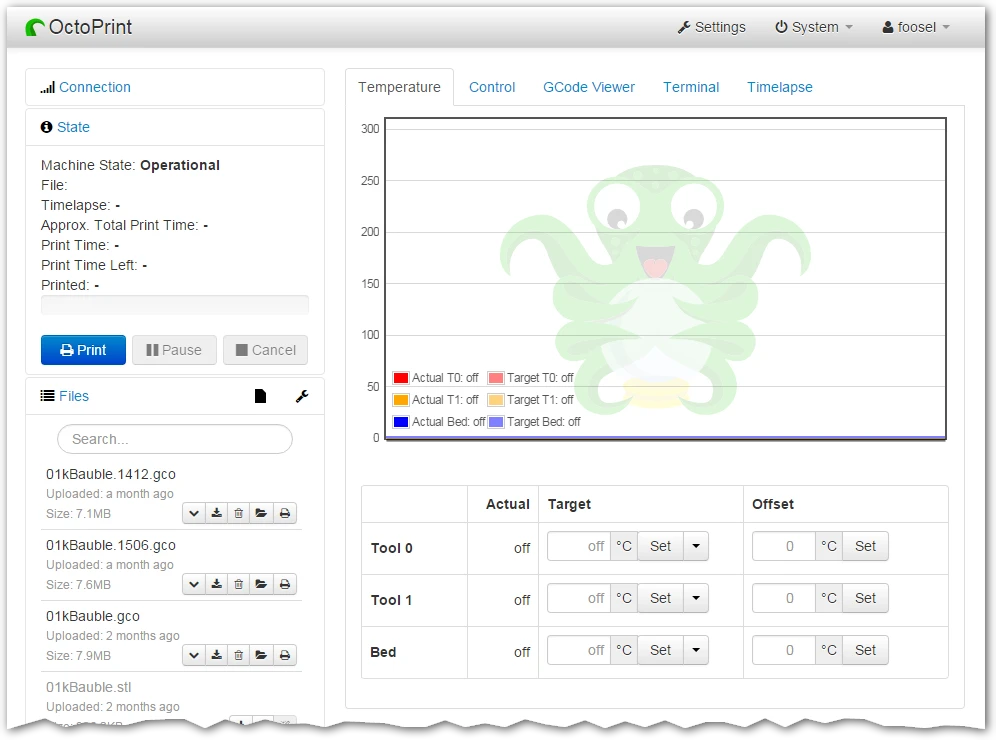
OctoPrint is an open-source web application that provides a remote interface for controlling and monitoring consumer 3D printers. It operates as a server that communicates with a printer via a network connection, allowing users to manage print jobs and hardware settings without needing a physical connection to the machine via a USB cable or SD card.
The software is typically deployed on a server or a single-board computer, with a specific distribution called OctoPi targeted for the Raspberry Pi. Users access the control panel through a standard web browser to send G-code commands to the printer and track the progress of manufacturing tasks from any device on the same network.
Key features
- Remote control of consumer 3D printers via a web interface
- Network based printer monitoring and status tracking
- Support for a dedicated plugin repository to extend core functionality
- Integration with the OctoPi distribution for Raspberry Pi hardware
- Community driven knowledge base and detailed technical documentation
- Support for remote print job management and file uploads
- Open source release under the GNU Affero General Public License V3
Built using Python, OctoPrint is designed for makers and hobbyists who require a centralized way to manage their 3D printing hardware. The architecture supports extensibility through an official plugin system, which allows the community to develop and share new capabilities to enhance the core server. This modular approach ensures that the software can adapt to various printer models and user requirements. The project relies on community contributions for code development, debugging, and documentation updates to maintain its stability.
OctoPrint serves as a specialized control panel for the 3D printing community, providing a bridge between computer software and physical manufacturing hardware.
Similar Open Source Software

CasaOS
A personal cloud system for managing home servers through a visual interface and Docker container deployment.

1Panel
A web based Linux server control panel for managing websites, databases, containers, and AI agent runtimes.


Join our newsletter to get shiny new open source software delivered to your inbox. Unsubscribe anytime.