
Monitors network services, host resources, and infrastructure health with a plugin system for custom service monitoring methods.
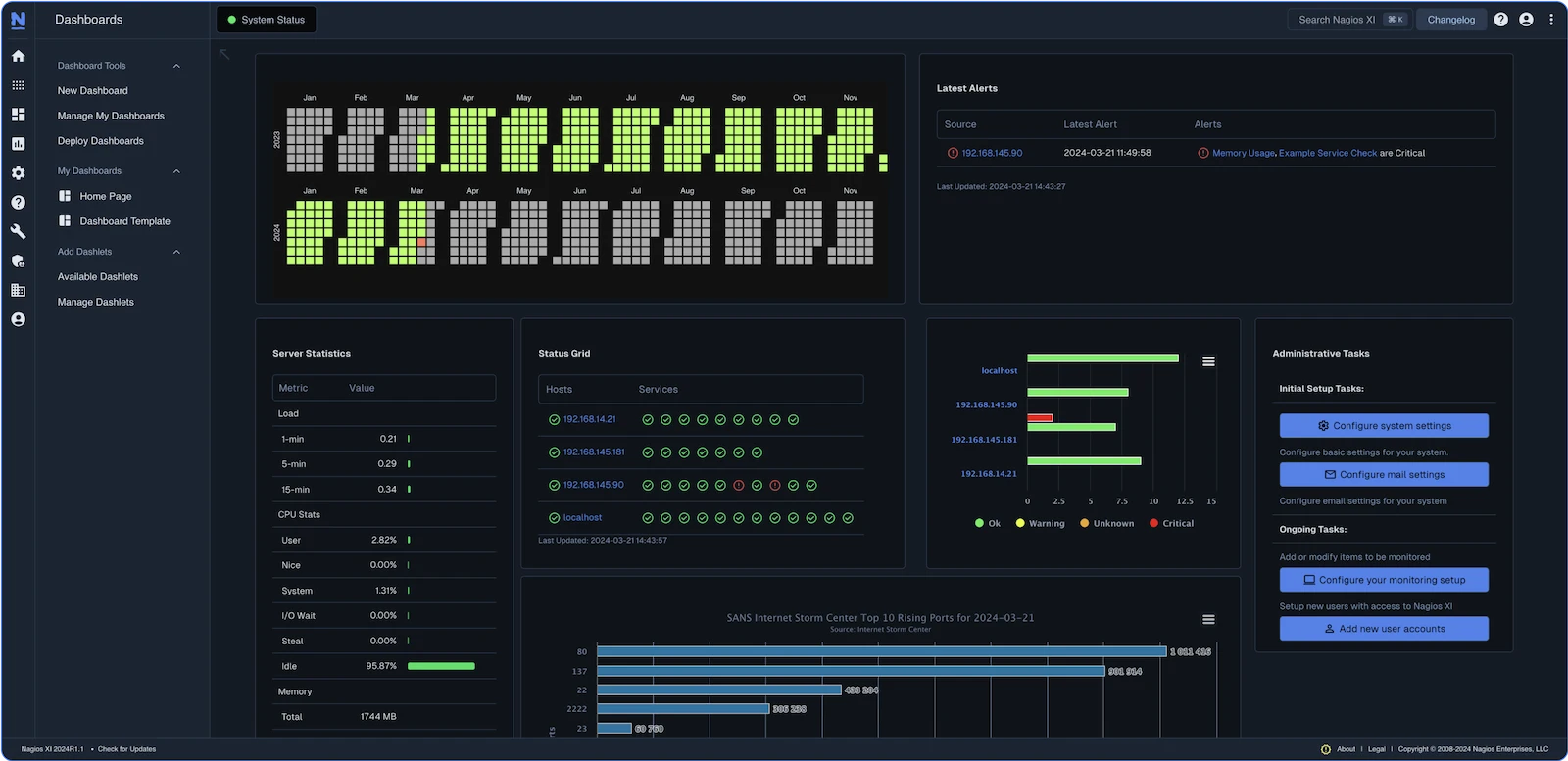
Nagios is an open-source application that provides comprehensive monitoring for hosts, services, and networks. It operates as a server-side application written in C, allowing administrators to track the health of their IT infrastructure from a centralized location. The software is designed to identify failures in real time and notify the appropriate personnel to minimize downtime.
The software is deployed on a server and includes CGI programs that provide a web interface for viewing current status and historical data. It is used to track system uptime, resource utilization, and the availability of network services across a variety of hardware and software environments. This setup allows for a centralized view of an entire network's health, making it a standard choice for managing complex server environments.
Key features
- Monitoring of network services via SMTP, POP3, HTTP, and PING
- Tracking of host resources including processor load and disk usage
- Plugin interface for creating user-developed service monitoring methods
- Network host hierarchy definition to distinguish between down and unreachable hosts
- Notifications via email, pager, or user-defined methods when problems occur
- Event handlers for proactive problem resolution
- Automatic log file rotation and archiving
- Web interface for viewing network status and problem history
Nagios uses a plugin-based architecture, which enables users to extend its monitoring capabilities by writing their own scripts to check specific services. This flexibility makes it suitable for system administrators who need to monitor non-standard applications or custom hardware that is not supported by default. The system manages dependencies through parent host definitions, which ensures that alerts are filtered based on the actual point of failure in the network topology, preventing alert fatigue caused by redundant notifications.
Because it is released under the GNU General Public License version 2, the software allows for deep customization and community-driven extensions. It is intended for technical users who require a high degree of control over how their infrastructure is polled and how alerts are routed through their organization.
It serves as a foundational tool for infrastructure monitoring in environments requiring granular control over alerting and status tracking.
Similar Open Source Software

NetData
Real-time infrastructure monitoring with per-second metrics and automatic discovery for servers, containers, and cloud environments.

Grafana
An observability platform for querying, visualizing, and alerting on metrics stored across multiple different data sources.



Join our newsletter to get shiny new open source software delivered to your inbox. Unsubscribe anytime.